1. The future is not coming, it is already humming in the workshop
If you walk through a traditional fabrication shop, you hear a certain sound. Grinders, oxy torches, manual layout on big plates, a lot of tape measures and handwritten notes. There is skill there, no doubt, but there is also a lot of variability and a lot of waiting.
Now picture a stainless specialist like National Stainless Steel Centre. Sheets and plates are logged into stock. Cutting programs move from CAD to laser and high-definition plasma machines. Waterjet equipment handles tricky jobs. CNC tube bending and section rolling shape components with repeatable precision. Welding bays are set up with clear procedures. Quality checks and job tracking run under ISO TÜV 9001 systems.
That is what the future of automation in steel fabrication actually looks like. Not a science fiction movie. A South African stainless operation in Kempton Park that has been evolving since 2008, building on a team heritage that goes back more than 30 years.
The big question is not whether automation, robotics and data will change stainless fabrication. They already have. The question is whether buyers in FMCG, mining, hospitals, hotel groups, commercial property and industrial sectors are ready to use those changes to their advantage.
To achieve true precision in stainless steel processing, NSSC offers a complete range of specialised cutting and fabrication solutions. Our advanced laser cutting services deliver unmatched accuracy and clean edges across all stainless steel grades, while our high-powered plasma cutting services provide fast, efficient results for thicker materials. For straightforward, high-speed sheet processing, our guillotine cutting services ensure perfectly straight cuts with minimal waste. When projects demand complex perforations or intricate profiles, our CNC punching services offer precision and repeatability at scale. Finally, for components that require exact weld preps or aesthetic finishing, our bevelling services deliver smooth, uniform edges that meet the highest fabrication standards.
2. What automation and data really mean for a buyer
Let me explain this in plain language, not buzzwords.
When fabricators talk about automation and data, they are talking about a few very practical things that affect your life as a buyer:
- Lead times that are predictable instead of “we will see how it goes”
- Parts that match drawings first time, so site work is faster
- Less waste on material, so costs are easier to justify
- Better traceability, so you know what grade went where
- Clearer pricing logic, so you can plan and report with confidence
Robotics and smart systems do not remove people. They change what people spend their energy on. Less time layout out parts by hand, more time solving real problems. Less time fixing avoidable errors, more time improving designs.
For you, that means fewer awkward calls to explain why a project is slipping, and fewer surprises when the invoice lands.
National Stainless Steel Centre operates exactly in that space, as a full-service stainless partner that combines material supply with in-house processing and a customer-first approach. Automation and data are not slogans, they are built into how work is planned and delivered.
3. Cutting and prep – where smart machines quietly save you money
Every stainless project starts with plate and sheet. How those plates are cut on day one ripples all the way through to installation.
On a modern floor, nesting software arranges parts to get the most out of each plate, balancing yield, heat input and machine time. Cutting tables driven by CNC take drawings directly from design teams. That is the backbone of a strong stainless steel processing workflow, even if nobody outside the workshop ever sees it.
At NSSC, cutting is handled by:
- Laser cutting for high precision profiles and tight tolerances
- High definition plasma cutting for heavier plate and robust work
- Waterjet cutting where heat must be kept low or materials are complex
- Guillotining for straight cuts on sheet and plate
Automation here is not only about speed. It is about consistency and waste reduction. Clever nesting reduces offcuts. Accurate cuts reduce rework and grinding. Clear digital job data reduces the chance that the wrong plate thickness lands on the wrong machine.
If you are buying for multiple sites or repeating designs across projects, that consistency adds up quickly. The same part cut today and cut in six months’ time will behave the same way, because the process behind it is controlled.
4. Welding and assembly – where robotics earn their keep
Cutting and forming prepare the pieces. Welding and assembly turn them into something you can install.
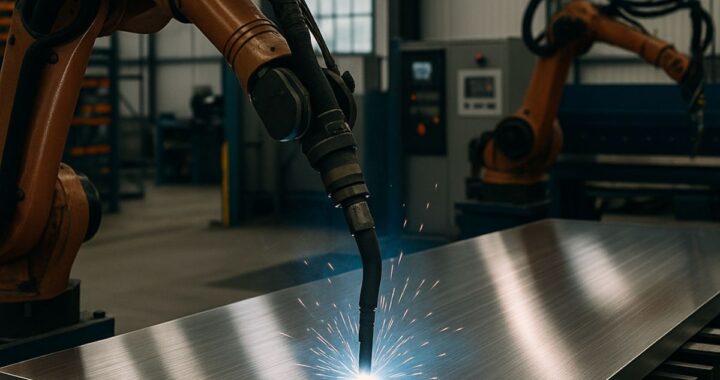
This is exactly where the conversation about robotic welding South Africa becomes real. It is not just a cool phrase. It is a practical answer to a common pain: repeatability.
Think about repetitive welds on handrail posts, frames, brackets, conveyor guards, tank skirts, ladder hoops, balustrade posts. A human can do them well. A human can also get tired, rushed or distracted. A robot does not get bored doing the same weld a hundred times.
Robotic or semi-automated welding cells, guided by good procedures and skilled technicians, bring:
- Consistent penetration and bead appearance
- Control of heat input, which protects stainless properties
- Less distortion on long members
- Shorter cycle times on high-repetition work
For buyers, that shows up as more uniform quality, fewer surprises on fit-up, and better aesthetics in architectural and semi-architectural applications.
It is important to say this clearly. Automation in welding is not about replacing skilled welders. It is about using their skill where it really counts, on complex joints and high consequence areas, while letting machines handle the grind of repetitive work.
NSSC’s welding capability sits in this modern middle ground. Manual skill where it is needed, supported by procedures, jigs and increasingly automated tools where consistency is king.
5. Data in the background – the quiet side of “Industry 4.0”
You do not see it on a finished component, but data is running in the background of every modern shop.
Machine controllers record run times. Job systems track which operator worked on which batch. Nesting software logs material yields. Quality checks are recorded against job numbers. Over time, this becomes a digital memory of how work actually flows.
This is where the idea of Industry 4.0 steel comes in. It sounds fancy, but in practice it means:
- Quoting that draws on real historical performance, not guesswork
- Capacity planning that understands bottlenecks ahead of time
- Maintenance that can be planned before machines fail
- Traceability, so you can link a component on your site back to the plate it came from
For you, that data pays off in a few ways:
- Smarter discussions about lead times and realistic deadlines
- Better documentation for audits in food, medical and industrial sectors
- Stronger justification when you argue for material choices in capex processes
NSSC’s ISO TÜV 9001 framework supports this data-driven way of working. It is not about drowning you in reports. It is about making sure that decisions about stainless are grounded in reality.
6. How this actually plays out in your sectors
Let us make it a bit more concrete and bring it into your world.
FMCG and food processing
In a bottling or dairy plant, stainless is everywhere. Platforms, pipe bridges, wash bays, guards, walkways, access ways. Automated cutting and forming make it easier to roll out standard modules across multiple sites, while data helps you track which designs gave the best life in harsh wash down environments.
Robotic or highly controlled welding supports hygiene by delivering smoother, more consistent welds that clean reliably. Integration with your own maintenance records ties together how design tweaks affected cleaning time and line availability.
Mining and minerals
Mines push stainless hard in launders, chutes, walkways, sumps and certain process vessels. Automation helps cut heavy plate accurately and bend or roll it repeatably, even on large components. Data on wear patterns and repair frequencies can loop back to design, material and thickness decisions.
Automation also helps manage safety. The more repetitive fabrication work that can be done in a controlled environment at NSSC’s Kempton Park facility, the less of that risk sits on your site, especially at height or in confined spaces.
Hospitals and healthcare
Stainless in hospitals is about hygiene, perception and durability. Theatres, CSSD areas, wards, kitchens and public spaces all lean on stainless for the surfaces that take constant cleaning.
Automated processing gives you repeatable cabinets, counters, rails and cladding that match standards across a group. Data and traceability help during compliance audits. Clean, consistent welds and finishes reduce dirt traps, which infection control teams appreciate even if they never see the cutting program that created the part.
Hotels and hospitality
For hotels and resorts, stainless is both back of house and front of house. Kitchens, laundry, plant rooms, balustrades, pool areas, bars, lifts.
Automation helps ensure that a custom balustrade design for one property can be reproduced or adapted reliably for another. Robotic welding and controlled polishing give you visible components that look the same across a portfolio, even when installed years apart.
Commercial property and industrial warehouses
In commercial foyers, parking structures, mezzanines and warehouse platforms, stainless and mild steel often mix. Using a centre that is geared for stainless and has strong processes reduces the chance of contamination from carbon steel work and improves the consistency of visible components.
Smart planning and data help with large roll-outs, such as standardised stair cores or safety structures across a national property portfolio.
7. NSSC’s role as a future ready stainless partner
So where does National Stainless Steel Centre stand in all of this?
NSSC is already running many of the pieces we have just described:
- Material stock in a wide range of grades, including duplex and other specialised alloys
- Laser cutting, high definition plasma cutting, waterjet cutting and guillotining for plate and sheet
- CNC tube bending, section and plate rolling, and bending for shapes and frames
- Polishing, deburring and finishing for both industrial and architectural applications
- CNC machining and milling for precise details
- Welding under structured procedures for reliable repeatability
Layer on ISO TÜV 9001 certification, BBBEE Level 3 status and a customer-first culture, and you have a partner that is not experimenting from scratch. NSSC is already a practical expression of where stainless fabrication in South Africa is heading.
Is every process completely automated and digitised? No, and that is actually healthy. The strongest model for the near future is a blend. Skilled people using advanced tools and data in a controlled environment, focused on delivering consistent quality for buyers who care about performance and total cost, not only the cheapest kilo this week.
8. What buyers can do now to make the most of these changes
Here is the good news. You do not need to overhaul your entire procurement strategy to benefit from automation and data in stainless fabrication. You can start with a few smart moves.
Share more context, not just measurements
Automation works best when the partner understands where the parts will live. Tell NSSC whether you are building for a coastal mine, a hospital theatre, a Durban hotel or a Gauteng warehouse. That helps them choose grades, finishes and processes that suit your reality.
Standardise where it makes sense
If you know you will repeat certain platforms, guards, stair types or rail details across sites, say so. NSSC can treat those as standard patterns, build efficient programs and deliver them more predictably.
Ask how data can help you
You do not need every log file. But you can ask for enough information to support your internal needs. For example, consistent naming of parts, batch records for certain grades, or simple summaries of material usage by project.
Think in assemblies, not only plates
An automated and integrated shop is well placed to deliver sub-assemblies, not just flat pieces. That can shorten installation time and reduce site risk. Work with NSSC to decide where that makes sense and where loose parts are still better.
Be open to feedback
Sometimes the data and experience on the fabrication side will suggest a design tweak that improves cost, lead time or performance. Being open to those suggestions is one of the quickest ways to gain value from a modern partner.
9. A practical “future ready” checklist for your next stainless project
To make this truly usable, here is a checklist you can lift straight into your next internal brief.
When you are planning a project with significant stainless content, ask:
- Have we specified not only dimensions, but also environment and sector context?
- Are grades and finishes chosen with long-term cleaning and corrosion in mind, not only first cost?
- Can we group repeating items so that automation can really help, for example, common platform modules or rail types?
- Have we asked our stainless partner how they will cut, form and weld, and how automation supports consistency?
- Do we have a clear view on where robotic or semi-automated welding can reduce risk and variation on repetitive items?
- Are our drawing standards and file formats aligned with a digital workflow, or are we creating manual work at every step?
- Have we defined what documentation and traceability we actually need, especially for food, medical or high-risk industrial jobs?
- Is there an opportunity to move more fabrication into the controlled environment of the stainless centre, reducing on-site hot work and improvisation?
If you can answer most of those with “yes, and NSSC is helping us with it”, you are already ahead of many organisations that are still treating stainless as an ad hoc, project by project scramble.
10. Preparing for the next ten years, not the last ten
Honestly, it is easy to think about automation, robotics and data as things that only big global players need to worry about. But if you look closely, you will see that the same forces are already shaping stainless work in South Africa.
Laser and waterjet cutting, CNC bending and rolling, smarter welding setups, better planning tools, traceability, integrated quality systems. These are not distant trends. They are part of how National Stainless Steel Centre operates every day from Kempton Park, serving mines, FMCG plants, hospitals, hotel groups, commercial properties and industrial clients across the country.
The phrase “future ready” can sound vague, so let us pin it down.
Being ready for the future of stainless fabrication means:
- Choosing partners that are already working in an automated and data aware way
- Sharing enough information that those partners can add value, not just fill orders
- Standardising and repeating smart designs instead of reinventing them every time
- Treating stainless as a long-term asset, not a short-term line item
If you do that, the buzzwords take care of themselves. You benefit from automation in steel fabrication, from the reality behind the phrase robotic welding South Africa, and from the quiet strength of an Industry 4.0 steel ecosystem that is slowly taking shape around you.
If you would like to see how this looks up close, or you have projects coming where stainless is more than a minor detail, it is a good moment to talk to NSSC. Bring your drawings, your timelines, and your headaches from recent projects. The team can help you map a cleaner, smarter path from spec to installation.
Because the future of stainless is not only about machines. It is about the decisions you make now about who you work with, and how you let technology support the reliability, safety and appearance of your sites for years to come.