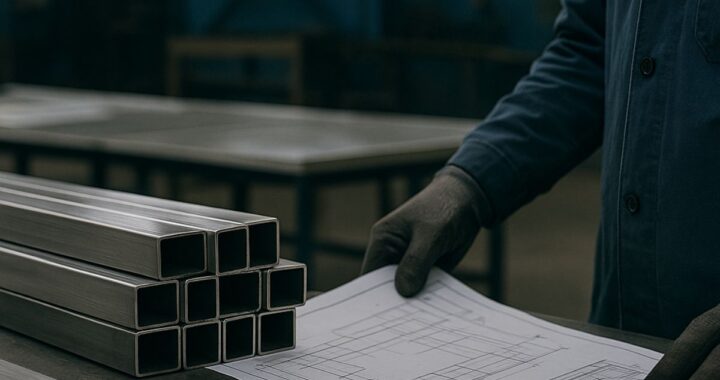
1. The old way: three suppliers, five phone calls and too many “almosts”
If you have ever run a stainless-heavy project, you know the usual story.
You buy plate from one supplier.
You send it to another shop for cutting.
Someone else bends and rolls.
A separate team welds and finishes.
Then everything arrives on site, where a contractor does a bit more “adjusting”.
Somewhere along the way, drawings change slightly, tolerances slip, edges get contaminated, and the programme absorbs a few extra days that nobody planned for.
Nothing is completely wrong, but a lot of things are a little bit off. Holes do not quite line up. A rolled shell is slightly out. That one bracket batch looks like it came from a different project entirely. People start grinding and reworking on site, right when you are supposed to be installing.
You know what? That is exactly the pain a real full-service stainless centre is meant to solve.
National Stainless Steel Centre (NSSC), operating from the corner of Pomona Road and 5th Avenue in Bredell, Kempton Park, is built around that idea. Material supply plus cutting, forming, machining, polishing and welding under one roof. ISO TÜV 9001 certification. BBBEE Level 3. Technical support and quick cut-to-size turnaround. The whole setup is about turning “a bit of plate and a good luck message” into a controlled journey from design to delivery.
Let’s walk that journey step by step, from a fabricator’s point of view, but in a way that makes sense for buyers too.
To achieve true precision in stainless steel processing, NSSC offers a complete range of specialised cutting and fabrication solutions. Our advanced laser cutting services deliver unmatched accuracy and clean edges across all stainless steel grades, while our high-powered plasma cutting services provide fast, efficient results for thicker materials. For straightforward, high-speed sheet processing, our guillotine cutting services ensure perfectly straight cuts with minimal waste. When projects demand complex perforations or intricate profiles, our CNC punching services offer precision and repeatability at scale. Finally, for components that require exact weld preps or aesthetic finishing, our bevelling services deliver smooth, uniform edges that meet the highest fabrication standards.
2. What a fabricator actually needs from a partner
On paper, you are buying tonnes of stainless. In reality, a fabricator needs something more subtle:
- Consistent material grades and thicknesses
- Reliable, accurate cutting
- Bends and rolls that match the model, not the nearest guess
- Machined details that let welders work, not swear
- Finishes that match the setting – factory, hospital, hotel, mine, warehouse
- Packaging and labelling that make sense to the installation crew
And above all, a flow.
A project only feels “smooth” when each stage is set up for the next. Cut parts that arrive mixed up, unlabelled or with rough edges push pain downstream. If you run multiple sites or multiple contractors, that pain multiplies fast.
NSSC’s whole reason for being is to give fabricators and buyers a single technical partner who understands that flow, from CAD file to installed component.
3. Step 1 – From concept and drawings to a clear scope
Everything starts with an idea and a drawing. Sometimes it is a full 3D model. Sometimes it is a well-marked PDF. Occasionally it is a sketch with a long explanation on the phone.
The first part of a good stainless steel processing workflow is getting that idea out of “designer language” and into “fabrication language”.
With NSSC, that looks like:
- Reviewing drawings and models with a stainless-aware eye
- Talking through environment, loads and sector (FMCG, mining, hospital, hotel, commercial, general industrial)
- Checking for obvious issues in weld access, bending radii or material over-specification
- Clarifying tolerances and critical interfaces
This is also where NSSC can suggest where cut-to-size makes sense, where full assemblies help, and where it is smarter to ship sub-assemblies that weld easily on site.
The goal at this stage is simple: a shared understanding of what the parts must do in the real world, not only on paper.
4. Step 2 – Material selection that matches reality, not wishful thinking
Once the scope is clear, the next step is picking grades and thicknesses. This part really matters.
A handrail in a Johannesburg office block does not need the same grade as a coastal mine walkway. A hospital CSSD table does not live the same life as a hotel kitchen shelf. A petrochemical header is not a mall balustrade.
NSSC carries a wide range of stainless sheets and plates, including duplex and other advanced alloys. That means grade selection can match:
- Corrosion exposure (chlorides, cleaning chemicals, coastal air, industrial pollution)
- Temperature and loading
- Hygiene needs in food or medical spaces
- Structural demands in mining or industrial settings
Having both the stock and the experience in one place means buyers can work with NSSC to get the balance right – not overspecified everywhere, not underspecified in critical spots.
The outcome is a material schedule that is realistic, traceable and aligned with long-term performance expectations.
5. Step 3 – Planning the workflow under one roof
Here’s the thing. Once you know what you are making and what you are making it from, the real magic is how the work is sequenced.
At NSSC, a project routing might look something like this:
- Plate and sheet pulled from stock, tagged to the job.
- Cutting programme prepared for laser, HD plasma or waterjet, depending on thickness and required edge quality.
- Straight cuts or simple blanks sent via guillotine where appropriate.
- Cut parts routed to forming (CNC tube bending, section rolling, plate rolling, press brake).
- Certain parts moved on to machining for slots, countersinks or precise features.
- Components grouped for welding into sub-assemblies.
- Assemblies sent through finishing – deburring, polishing, cleaning and, where needed, passivation.
- Final inspection, packing and labelling.
Because it all happens in one continuous lane, the chances of losing track, mislabelling or damaging parts are reduced. It is a genuine fabrication process, not a loose sequence stitched together between different shops.
For buyers, this means less chasing. For fabricators, it means less time fighting upstream mistakes.
6. Step 4 – Cutting: where accuracy and yield start
Cutting is usually the first “visible” step for a fabricator.
NSSC leans on several cutting technologies:
- Laser cutting for clean, accurate profiles with tight tolerances and sharp detail
- High-definition plasma cutting for thicker plate where laser is less economical
- Waterjet cutting where heat input must be minimal or material combinations are tricky
- Guillotining for straightforward straight cuts on sheet and plate
The advantage of having all these on one floor is that you are not forcing every job through a single method. Thinner, high-detail components for a hospital fit-out can sit on the same programme as heavy plate for a mine, each getting the process that suits it best.
Good cutting does something subtle. It sets the tone. When holes line up, edges are square and nests are intelligent, the rest of the workflow simply works better.
7. Step 5 – Forming: bends and curves that actually fit the model
After cutting comes shaping.
A balcony bracket that is a degree out will show up when the glass goes in. A rolled shell that is slightly oval will show up when flanges are fitted. A tube that is overbent will fight you at every connection.
NSSC uses:
- CNC tube bending for handrails, frames, pipe loops and guards
- Section rolling for channels, angles and beams needing radiused forms
- Plate rolling for tanks, ducts and cylindrical equipment
- Press brakes for folded components and brackets
CNC control and experienced operators mean you get repeatable bends and curves that match what the designer intended, not what the bender guessed.
For buyers, the benefit shows up in shorter installation times and fewer on-site “make it fit” sessions with grinders and big bars.
8. Step 6 – Machining the details
Not every stainless job needs machining, but whenever you introduce:
- Slotted holes
- Countersunk fasteners
- Precise spigot fits
- Tapped holes
- Tight-tolerance interfaces
you are crossing from simple cutting into the world of machining and milling.
NSSC’s CNC machining and milling capability lets those features be planned in the same job, not treated as a separate project with a different supplier.
That matters because a machinist who can talk to the person who programmed the laser or set up the rolling job can sort small issues before they turn into big site headaches.
The result is components that weld and bolt together without improvisation.
9. Step 7 – Welding and assembly: the heart of the workflow
This is where stainless lives or dies. You can get everything right up to this point and still suffer if welding is sloppy or underplanned.
NSSC approaches welding with stainless-specific care:
- Thoughtful joint design
- Proper fit-up, using the accurately cut and formed components
- Controlled heat input and shielding to protect material properties
- Correct filler materials for the grade
- Attention to distortion and straightness on structural members
For some jobs, NSSC will deliver loose parts for a fabricator to assemble. For others, sub-assemblies or near-complete units make the most sense, especially when installation time on site is tight or access is difficult.
The key is that welding is integrated into the same project flow that supplied and processed the steel, instead of being an afterthought bolted on at the end.
10. Step 8 – Finishing: the human-facing side of stainless
Even on heavily industrial projects, someone will eventually touch the steel.
That might be a plant operator on a platform, a nurse pushing a trolley along a hospital rail, a guest leaning on a balcony, or a maintenance tech grabbing a ladder rung on a mine.
Finishing is where stainless shifts from “fabricated piece” to “part of someone’s daily environment”.
NSSC handles:
- Deburring of edges so there are no sharp lips or burrs
- Stainless steel polishing from basic finishes to brushed and high polish, depending on application
- Cleaning, removing heat tint and surface contamination
- Passivation and related treatments where corrosion resistance needs an extra boost
This is also where architectural details and hygienic requirements get translated into physical surfaces. A brushed rail in a hotel needs quite a different feel compared to a polished piece in a theatre environment.
When finishing lives in the same workflow as cutting, forming and welding, you get an even look across all parts, not a patchwork of different sheens and edge qualities.
11. Step 9 – Quality, labelling, packing and dispatch
A beautiful fabricated component is not much use if it arrives scuffed, mixed up or half-labelled.
NSSC’s ISO TÜV 9001 quality system covers:
- Material traceability – grade, batch, and certificates where needed
- Dimensional checks on critical parts and interfaces
- Weld and finish inspection to agreed criteria
- Visual checks for damage or contamination
Packed parts are then:
- Labelled in ways that match drawings and installation schedules
- Grouped logically for site work (by area, sequence or assembly)
- Protected against transport damage with appropriate wrapping and separation
From NSSC’s site in Kempton Park, components move across South Africa to factories, warehouses, mines, hospitals, hotels and commercial buildings. When that last plastic cover comes off on a site hundreds of kilometres away, the buyer should feel that the piece in front of them matches what they signed off on weeks or months earlier.
That is what a controlled workflow is really about.
12. How this feels from the buyer’s side
So far, we have spoken as if you are the fabricator. Let us flip it and look from a buyer’s desk.
You may be responsible for:
- A group of FMCG plants
- A mining operation with several processing areas
- A hospital group or private clinic network
- A hotel or resort portfolio
- A mixed commercial and industrial property portfolio
Your daily life does not revolve around weld prep and bending radii. It revolves around budgets, timelines, safety, compliance and uptime.
Working with a centre like NSSC gives you a few quiet advantages:
- One accountable partner across multiple steps of the chain
- Better predictability on lead times because fewer handovers are involved
- Fewer quality disputes as material, processing and assembly are under one umbrella
- Easier standardisation across sites because the same people handle recurring designs
You do not need to manage the workshop in detail. You just need to know that the workshop is set up in a way that supports your risk profile instead of fighting it.
13. Why a full-service steel centre changes the risk picture
It is tempting to think a full-service steel centre is just about convenience. One invoice instead of three, fewer phone calls, one delivery instead of several.
The bigger picture is risk.
Every handover between separate suppliers introduces uncertainty:
- Will the next shop honour the material traceability?
- Will cutting mistakes be caught before forming, or will they show up on site?
- Will someone grind away a marking that was your only grade reference?
- Will welders know what filler to use on the grade you specified?
When all those stages sit inside one integrated process, under one quality system and one technical leadership, the chances of something important slipping through are lower.
You also gain something that is hard to price: shared learning. NSSC sees the results of its own work on repeat projects. If a certain detail keeps causing pain for installers, the team can adjust the workflow or suggest a tweak to the design. That feedback loop is much harder to create between separate, disconnected suppliers.
14. A quick checklist for your next stainless-heavy project
To make this practical, here is a checklist you can use when talking to NSSC or any stainless partner:
- Have we shared not only drawings, but also environment and sector context?
- Are material grades clearly specified for each area, with reasons understood?
- Is there a clear plan for cutting, forming, machining and welding as one flow?
- Do we know which parts should arrive as loose items, which as sub-assemblies?
- Have finishing requirements been spelled out, especially where people touch the steel?
- Are quality documents and traceability needs written into the scope?
- Have we discussed packing and labelling so installation crews get parts in a usable order?
If you can tick off most of these with NSSC as your partner, your stainless projects start looking a lot less like a gamble and a lot more like a predictable routine.
15. From drawing board to truck bed – closing the loop with NSSC
From concept to cut plate, from formed sections to clean welds, from polished surfaces to labelled pallets on a truck, a good stainless steel processing workflow is really a story about control.
NSSC has built that story into its operation in Bredell, Kempton Park. Stainless plate and sheet inventory, duplex and other grades where needed. Laser, high-definition plasma and waterjet cutting. Guillotining. CNC tube bending, section and plate rolling. Bending, polishing, CNC machining and milling. Welding. All running under ISO TÜV 9001, backed by BBBEE Level 3, and wrapped in a customer-first mindset that recognises you are not buying metal, you are buying outcomes on your site.
For buyers in FMCG, mines, hospitals, hotel groups, commercial property and general industry, the invitation is simple: stop treating stainless as a loose collection of suppliers and start treating it as a joined-up fabrication process with a partner who lives it every day.
If you have projects coming up, or if you are tired of juggling multiple shops and dealing with surprises on site, it might be time to pull NSSC into the conversation early. Send the drawings. Share the headaches from past jobs. Let their team help you map a clean path from design to delivery.
Because stainless steel can either be a quiet, reliable backbone of your operation, or a recurring source of small disasters. The difference is seldom the grade alone. It is usually the workflow, and the people who own it with you.